Introduction to Literature • Corrigan • Spring 2012

tree image

Wednesday, April 4, 2012

Special Post #2 (Interpretation), April 17

The second "special post" will be due before class on April 17. You have up until class time to complete it, rather than midnight the evening before. Bring a printed copy of it to class in addition to posting it on your blog.

For this entry, you will take one of the works that we've read this semester and write an interpretation of it--or of part of it, if it is long or if you want to look very closely at a smaller part of it. Instructions are as follows. Do each of the following in the order presented, and make sure to number each part in the post.
1. Re-present the part of the text you are interpreting. In other words, explain what you are going to be talking about so that readers can follow you without having the text in front of them: use a mixture of summary, paraphrase, and brief quotations to help us see what you are going to be talking about. Don’t give us the whole story but just the pertinent parts.

2. Explain why the part of the text that you've chosen to focus on needs to be interpreted. In other words, explain why the full meaning isn't quite clear on the first read. This means that you need to choose a part of a text that isn't quite clear. Keep in mind that sometimes texts are “deceptively simple.” Part of what you could do is show how something that seems clear at first really isn't.

3. Tell what you take the work to mean. This is the core part of the “interpretation.” This is where you will give the “thesis” of your interpretive essay. All of the other parts of the essay serve to set up, demonstrate, and unpack this main point. You might begin this part of your essay by saying: “This story is about . . .”.” or “A central theme in this scene in this play is . . .” or “This image can be taken to represent . . .” or “This character stands for . . .” or “What this metaphor points to is . . .” You don’t need to present your interpretation as “the” definitive interpretation but only as a useful one.

4. Supply evidence from the text to support your interpretation. This is where you give your reasons for why you interpret the story the way you do. Point to and explain specific details in the story as “evidence.” Also, make sure that readers can see the connection between your evidence and what you say that that evidence supports. Don't assume that they'll see the same connection as you. This means that your interpretation should be feasible based on what the text actually says, even if you want to make an interpretation that “stretches” a bit or that is particularly creative. You might begin this part of the  essay by saying “The details in the text that point to the reading I've just given include . . .” or “There are several bits of evidence for such an interpretation . . .”

5. Explain why or how the interpretation matters or could matter for yourself and/or for the reader. This might be the most tentative part. But it's also one of the most important parts. The question is: So what? Who cares? What implications might the text in the way you are interpreting it have for how we live and how we understand ourselves, our neighbors, the world we live in, or God?
    Make your interpretation at least 900 words long. Quotations should not count towards the word total.

    The five sections are not merely parallel reflections but rather distinct parts of a whole, individual moves to set up, state, demonstrate, and unpack a central interpretive argument—the “thesis” where you tell what you take the work to mean. The five sections should be connected to each other and build on each other. It should be clear that each of the five sections accomplishes the different things that the instructions ask for from each. Good transitions will help explain the relationship between the sections.

    The interpretation—the central thesis and the supporting sections—should show a deep understanding of the text, going beyond stating the obvious, and offering insight.

    When quotes are used, they should be introduced and then commented on, never just dropped in or allowed to “speak for themselves.” Also, quotations should be mostly short and are mixed in with paraphrase and summary.

    Below are some practical pointers for writing:
        • Start as soon as you can.
        • Read the text you are writing about carefully several times.
        • If you don’t have any ideas, simply start out by “paraphrasing” the text you are writing about the best you can. This writing won’t go into the essay, but it will get you thinking about what to say.
        • Don’t feel that you need to know what your interpretation is going to be before you start writing about it. Get a paper copy of the texts you are writing about that you can take lots of notes on. Actually write on the text as many questions, comments, connections, observations as you can. (Something like in the picture above.)
        • Write as many questions as you can.
        • Note problematic lines. These are sometimes your best friend in terms of coming up with something to write about.
        • Get someone to talk with you about the text and about your interpretation.
        • Look for patterns and connections within the text. Ask what these patterns might mean. Ask what ideas or thoughts or themes they might be trying to emphasize or connect.
        • Don’t feel that your interpretation has to be “final” or conclusive. Embrace complexity.

        Wednesday, March 28, 2012

        Circle B Bar Nature Reserve Field Trip, April 3

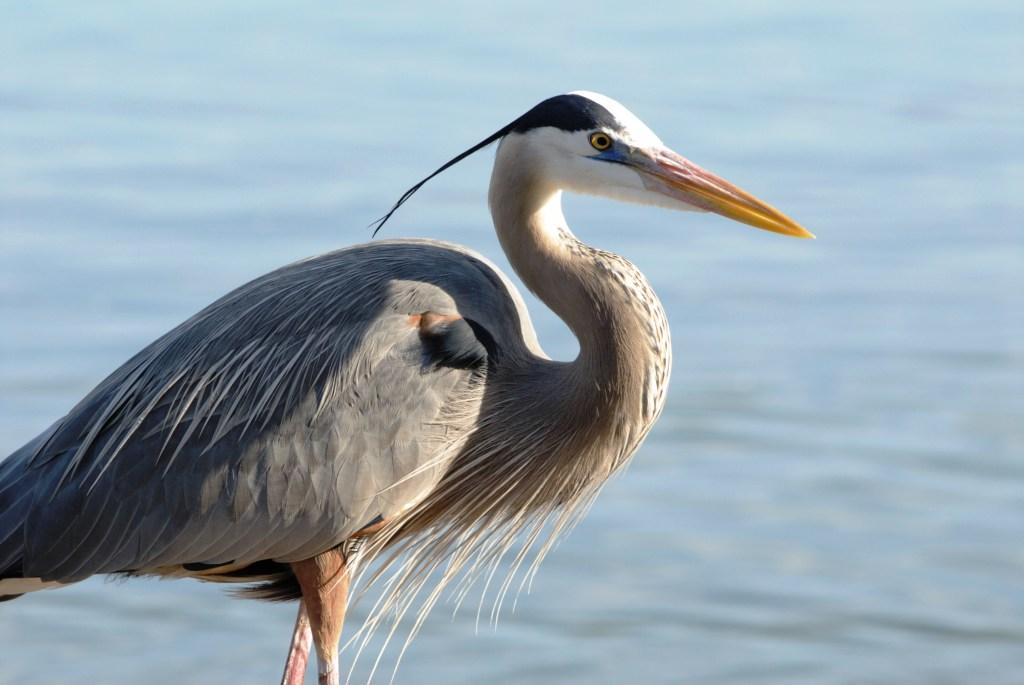
        Great Blue Heron photographed at Circle B
        from "Birdwatching from a Christian Perspective"
        Set on Lake Hancock here in Polk County, Circle B Bar is a stunningly beautiful nature reserve that features a Nature Discovery Center, hiking trails, and restored wetlands. It's a wonderful place to spend time outdoors and to see wildlife, especially birds. Like all wetlands, it also serves an important environmental function in our watershed. In conjunction with reading and writing some nature poetry, we will be visiting the reserve to take a tour, learn a little about the environment, spend some time in nature, and do some community service.

        We will visit on Tuesday, April 3, from 9:20-11:30 AM.

        You will need to wear clothing appropriate for the setting. Suggested things to wear/bring: closed-toed shoes, shorts, t-shirt, hat, sun screen, bug repellent, water bottle, and some sort of snack like a granola bar. A camera would be nice but is optional. However, do make sure to bring a notebook, something to write with, and copies of the texts for the day.

        You will have to arrange your own transportation. Carpooling is encouraged. Circle B is about 6.5 miles from Southeastern. (See map.) Please make sure to arrive on time.

        The community service will involve pulling non-native invasive species of grass from some plots of uplands that are undergoing restoration. You may want to bring gloves. Prepare to get a little sweaty and dirty.

        Though we may have to be flexible, the planned itinerary is as follows:
        • Take a tram ride tour to the uplands
        • Spend some time sitting in nature and reading nature poetry
        • Community service project in uplands
        • Continue tour on tram
        • Return to Nature Discover Center to discuss visit

        Thursday, March 22, 2012

        Lake Bonny Park Field Trip

        Before class on Tuesday, March 27, you will need to visit Lake Bonny Park. The park is off Bartow Rd., directly across from Lakeland High School, about five minutes from Southeastern: see map.

        The purpose of this activity is to give you yet another opportunity to undertake the spiritual practice of paying attention, which is a practice of poets like Mary Oliver and of theologians like St. Augustine.

        The instructions are as follows:
        • Before you go, make sure to have read the texts assigned for the following class period (some poems by Mary Oliver and a paragraph by me). Also, when you go, bring these instructions with you.
        • Go with someone else. But do not spend much time talking.
        • Go preferably in the morning or evening when it is cool.
        • Find a quiet place to sit or stand in nature. There is a walking path that goes around the park and there is an elevated wooden walkway that goes out over Lake Bonny. 
        • Be still, be quiet, pay attention, watch, and listen.
        • Stay at the park for a minimum of 45 minutes; stay still and silent for at least fifteen minutes.
        • Don't read or write during the fifteen minutes of stillness.
        • Write a nature poem of your own at least 20 lines (or several shorter poems adding up to that much). 
        • In addition to meeting the prompt, include your poem in your post for the next class. Since writing these poems is part of this field trip, they do not count towards the 300 word minimum for the post.
        • Also, include in that post the following statement: "I went to Lake Bonny Park for this field trip, and I stayed there for at least 45 minutes." If you were there for less time, indicate the amount of time you were there for. 

        Saturday, March 10, 2012

        AFI Field Trip, March 20

        Alliance for Independence (AFI) has worked with adults with mental disabilities in Lakeland for over 50 years. In conjunction with reading Tom Griffin's The Boys Next Door, we will be visiting their facility to take a tour, learn about their work, and do some community service.

        We will visit on Tuesday, March 20, from 9:12-11:15ish AM. This is during chapel time and class time.

        You will have to arrange your own transportation. Carpooling is encouraged. AFI is 1.5 miles from Southeastern. (See map.) Please make sure to arrive on time.

        The community service we will do will involve taking turns reading a story with the adults who AFI serves. When we do this, the plan is to break into several groups.


        Thursday, March 8, 2012

        Midterm Exam Grades

        Midterm Exam Grades have been posted in Blackboard.

        Thursday, February 23, 2012

        Midterm Exam Study Guide

        The midterm exam may cover anything that we've read or discussed so far in this semester. It may include True / False, Multiple Choice, Matching, Short Answer, and/or Essay Questions. I expect the exam to be fair and solid, aimed at finding out what you do know rather than getting you for what you don't know. If you have questions that this study guide does not cover, please ask them in the comment section below. That way, everyone will be able to see the answers.

        Literary Texts -- For these, you should be able to identify characteristic passages, matching them to author and text. You should also know some general things about the author’s biographies where headnotes are provided. You don't have to be able to recall minute details about texts. But you will have to be familiar with the texts and have a sense of the way they sound, feel, etc., so that if I give you a passage from, say, "This Blessed House" and a passage from "Sure Thing," you should be able to know which is which even if you don't specifically remember those exact passages.
        • "Frankie and Johnny"
        • David Ives, "Sure Thing"
        • Margaret Atwood, "Happy Endings"
        • Naomi Shihab Nye, "The Traveling Onion"
        • Raymond Carver, Headnote and "What We Talk about When We Talk about Love"
        • Jhumpa Lahiri, Headnote and "This Blessed House"
        • David St. John, "My Tea with Madame Descartes"
        • Robert Hass, Headnote and "A Story about the Body"
        • Carolyn Forche, Headnote and "The Colonel"
        • "Undo" and "The Ark" (videos)
        • The Book of Joel
        • C. S. Lewis, A Grief Observed
        • Naomi Shihab Nye, Selected Poems from Words Under the Words
        Texts, Concepts, and Practices for Reading Literature -- For these, you should make sure that you understand and be able to apply the concepts discussed. You should be able to explain the rationale for activities and field trips.
        • Corrigan, "Literature Is a Thing You Do as Part of Life"
        • Pearson, “Active Reading of Literature”
        • Pearson, “Why Read Literature”
        • Francis X. McAloon, "Reading for Transformation . . . "
        • Corrigan, “Darkness, Questions, Poetry, and Spiritual Hope”
        • Notes on Sound
        • Notes on Character
        • Notes on Art, Meaning, Theme, and Interpretation
        • Notes on A Grief Observed
        • The “onion” poem experiment
        • Reading out loud outdoors
        • Painting in response to reading
        • Tuscana Ristorante field trip
        • Cemetery field trip
        • Sacred reading / lectio divina
        Example Questions

        1. Explain the following statement and explain what it has to do with reading literature: “Who a person is is more than what can be seen, more even than who that person lives as.”
        2. Who wrote the following passage, and what text does it appear in:
        You'll have to face it, the endings are the same however you slice it. Don't be deluded by any other endings, they're all fake, either deliberately fake, with malicious intent to deceive, or just motivated by excessive optimism if not by downright sentimentality.
        The only authentic ending is the one provided here:
        John and Mary die. John and Mary die. John and Mary die.

        1. According to Corrigan, doubt and uncertainty are often signs of weak faith.

          Circle one:           True       False
        2. Which of the following is true about sound in literature:
        a.      An abundance of soft, flowing words are necessary for a piece of literature to sound musical.
        b.     Though there are many, many types of literary devices associated with sound, rhyme is the most commonly used and the most important.
        c.      Repetition without variation is the basis of all sound and musicality in literature.
        d.     Assonance is the repetition of vowel sounds within words.
        e.     All of the above.
        1. In “Reading for Transformation” Francis McAloon suggests that people reading poetry ought to explore what?
        a.      The details of the text itself
        b.     The historical context in which it was written, including the personal life of the poet
        c.      The possible implications of the text for the reader
        d.     All of the above.
        e.     Something else not listed here.

        Monday, February 20, 2012

        Cemetery Field Trip

        Before class on Thursday, February 23, you will need to visit the oldest burial gardens in Lakeland, three connected cemeteries called Lakeview, Roselawn and Tiger Flowers. You will need to spend a minimum of a full 40 minutes inside the cemetery. These burial gardens are located less than ten minutes from Southeastern, at the corner of Ingraham Avenue and Parker Street (map). Parking is available across Ingram from the cemeteries, in the parking lot of the Polk County Government Center. I suggest that you enter the Tiger Flowers Cemetery entrance directly across from Everest University. You are responsible for arranging you own transportation, but I encourage you to carpool with other members of the class.

        Since this cemetery is located downtown, you should use common safety sense. For instance, go during the day and go with someone.

        The purpose of this trip is to "inform" your reading of C. S. Lewis' A Grief Observed. Specifically, it may "illustrate" Lewis' discussion of a man caring for his dead mother's grave site in Chapter 2 (page 21 in my book). More generally, it should give you a quite time to reflect on death and on the book as a whole.

        You will need to bring the text of A Grief Observed with you to the cemetery. You should arrive at the cemetery quietly and solemnly. This is a public place of grief. You need to show respect for the dead and especially for those still alive who have dead loved ones buried there. During your visit, I would like for you to spend most of your time walking around in silence, looking at the tombstones, and reading.  Please reread select pages and passages carefully and meditatively. This should be a "prayerful" event. It should also be an event that takes you deeper into the text and into life.

        To be counted as "present," for this field trip, you will need to include the following statement as part of your post for the following class: "I went to the Lakeview, Roselawn and Tiger Flowers cemetery complex for this fieldtrip, and I stayed there for at least 40 minutes." Optimally, you will also post a picture of yourself at the cemetery. You may also want to add some reflections about your visit and/or connections with A Grief Observed.

        If visiting this specific cemetery provides some hardship, you may arrange with me to visit a different one, providing that it is comparably old and large.

        If you think that visiting a cemetery at all will prove too emotionally difficult for you, you may arrange in advance with me for an alternative activity.